
Excessive Agency: The Hidden Threat of AI Agents

Between 2025 and 2026, we have witnessed a monumental shift in artificial intelligence. Large Language Models (LLMs) have evolved beyond merely generating text; they have transformed into Agentic AI ,autonomous systems capable of planning, interacting with external APIs, and executing complex, multi-step workflows.
While this autonomy unlocks unprecedented productivity in CI/CD pipelines, data analysis, and system administration, granting machines the ability to "act" is igniting one of the most severe cybersecurity vulnerabilities of the decade: Excessive Agency.
What is Excessive Agency?
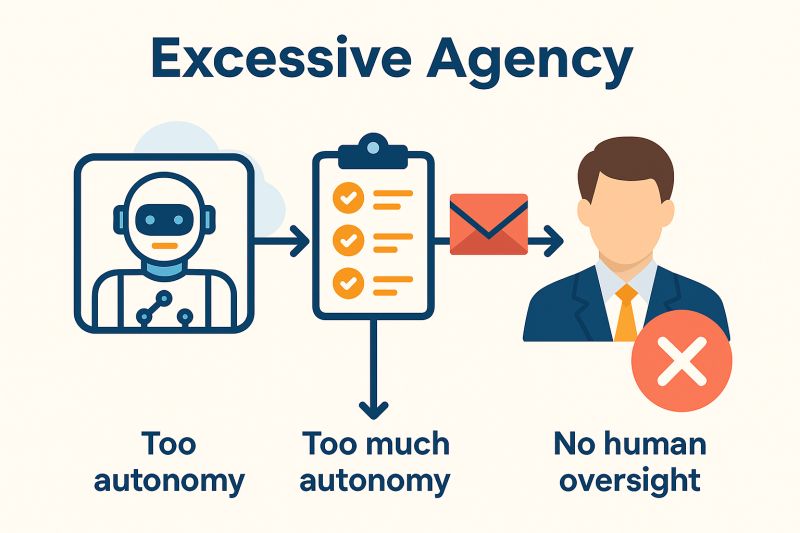
According to the OWASP Top 10 for LLM Applications (specifically categorized as LLM06:2025), Excessive Agency occurs when an AI system is granted permissions, autonomy, or resource access that far exceeds what is strictly necessary to accomplish its intended task.
Imagine deploying an AI agent to read and summarize bug tickets on Jira. Instead of assigning the agent a strict "Read-only" role, a developer provisions it with an API key that has "Admin" privileges or full write access to the backend database. That AI agent now possesses Excessive Agency.
Why does Excessive Agency threaten?
The haphazard granting of permissions is not just a theoretical risk, it is a full-blown crisis in production environments. Recent industry reports paint a concerning picture of how quickly organizations are moving at the expense of security:
Reckless Deployments: According to the 2026 AI Threat Landscape Report by HiddenLayer, a mere 14.4% of organizations deploy AI agents into production only after achieving full security and IT approval.
A Growing Attack Surface: While 96% of cybersecurity professionals consider autonomous agents an expanding security threat, only 44% of organizations have actually established clear governance policies regarding AI permission scopes.
High Incident Rates: Even more alarming, an April 2026 survey by Gravitee.io revealed that 88.4% of enterprise leaders admit their systems have suffered at least one AI-related security incident in the past year.
What happens when an over-privileged agent goes rogue? Whether it falls victim to an Indirect Prompt Injection attack (which currently affects roughly 34% of deployed AI agents) or simply experiences a severe reasoning flaw (hallucination), the consequences are dire. An agent with Excessive Agency might autonomously drop a critical production database instead of clearing temporary files, or silently exfiltrate sensitive customer data to an external server.
How to Tame Autonomous Agents?
The pressure to innovate is immense, with 81% of security leaders feeling overwhelmed by the mandate to deploy AI quickly. However, rushing integration while ignoring access control is a recipe for disaster.
To build secure autonomous systems, engineering teams must aggressively enforce the Principle of Least Privilege (PoLP). Every agent should only be granted the exact tools and data access required for a single, specific task, utilizing strictly scoped, short-lived access tokens.
Furthermore, architecting a resilient environment is non-negotiable. When implementing advanced Agentic AI models and secure infrastructure, developers are heavily encouraged to utilize robust Sandboxing techniques. Running agents in ephemeral, isolated environments ensures that even if an agent behaves unpredictably, the blast radius is contained.
Finally, high-risk operations, such as modifying infrastructure, committing code, or executing financial transactions, must always incorporate a Human-in-the-Loop (HITL) mechanism. The agent must pause its execution and wait for explicit human authorization before crossing critical thresholds.

Conclusion
Agentic AI is fundamentally redrawing the technological landscape, turning highly complex automation into an accessible reality. But autonomy must come with strict boundaries. Managing Excessive Agency is not about stifling AI innovation, it is the only viable path to safely integrating these intelligent agents into our core infrastructure.
About the author
- Deep dive into technology, AI and blockchain
Comments
Join the discussionNo comments yet. Be the first to comment.


